AV Storytelling for Sustainable Habits


Buildings fluent in data log kilowatt-hours, CO₂ levels, water flow, occupancy, and weather response in minute detail. Yet day-to-day behaviors—the micro-choices that determine whether a building performs as designed—rarely change because the story remains locked inside dashboards meant for operators and executives. If we want better outcomes, we have to move beyond “screens in a basement” and turn performance data into felt experiences at the point of decision. This article offers a practical, ethics-forward way to do that by blending Elinor Ostrom’s commons framework with exhibit-style storytelling and immersive audio-visual (AV) cues distributed through the building.

The Building as a Narrator
Energy, air, water, and shared space are common-pool resources (CPR). Everyone benefits from their good stewardship; everyone can deplete them. Communities can manage CPRs successfully when certain design principles are in place. Translate those principles to the built environment and the building becomes more than a container for activity; it becomes a co-narrator that helps people understand consequences and make better choices—without shaming or micromanaging.
To operationalize this, we use a simple method: Data → Meaning → Metaphor → Modality
- Data: What signal is changing? (CO₂, outlet load, chilled water flow, elevator calls)
- Meaning: Why does it matter right now? (comfort, health, carbon, cost, congestion)
- Metaphor: What relatable story device explains it? (breath, hourglass, current, pulse)
- Modality: How does the building “speak”? (light, sound, motion graphic, gentle haptic) Place where decisions happen?
This keeps technology in service of a story that aligns with organizational values—water stewardship, energy efficiency, indoor air quality—rather than tech for tech’s sake.
What Museums Do Differently (And What Buildings Can Borrow)
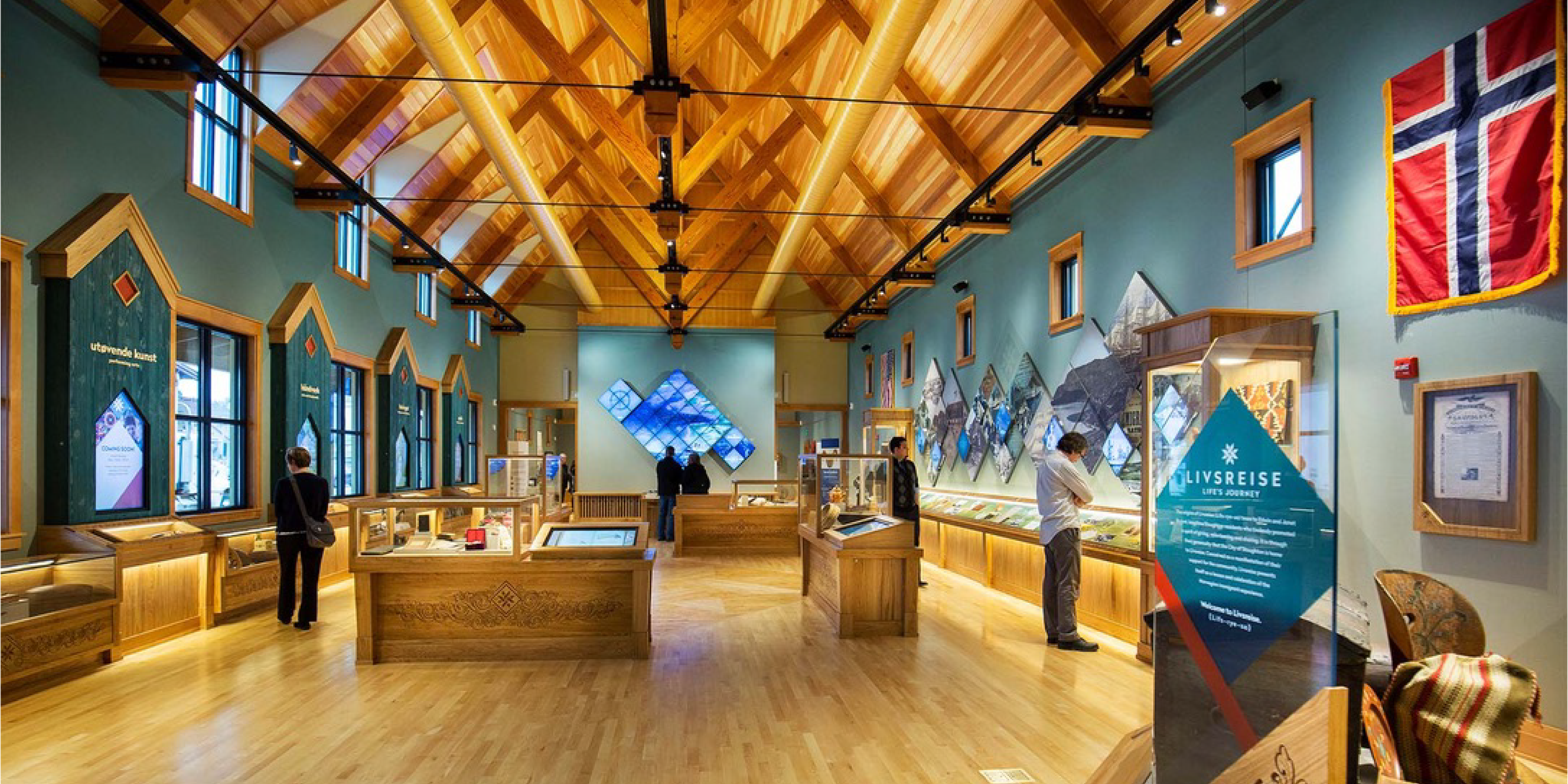
Exhibit designers excel at turning abstractions into experiences. They use threshold moments (revelations at entries), glanceable cues (you “get it” in three seconds), multisensory layers (light, sound, and motion), participation (press, step, & vote), and pacing (quiet build, peak, & release) to move visitors from curiosity to comprehension and then to action. Buildings can adopt the same playbook. Instead of a single digital KPI wall, distribute small, meaningful cues throughout circulation paths, meeting rooms, dining areas, and lobbies—where choices are made.
USING OSTROM’S EIGHT PRINCIPLES TO DESIGN MOVES
1) Clearly defined boundaries
People steward what they can experience. Make the resource and its “budget” experienced at the scales that matter. A lobby halo might show the building’s progress toward today’s energy target; a meeting-room perimeter LED with auditory chimes could indicate “freshness” of air. Boundaries can be spatial (this floor), temporal (today), and thematic (water this week). When boundaries are clear, responsibility becomes shared rather than abstract.
2) Congruence with local conditions
Signals should match the room’s purpose, culture, and even weather. A library may use quieter, slower light changes for IAQ feedback; a café can tolerate playful motion. On sunny days, nudge occupants toward shifting energy-intensive tasks to off-peak hours; on cool nights, celebrate free-cooling opportunities. Congruence avoids alarm fatigue and builds trust.
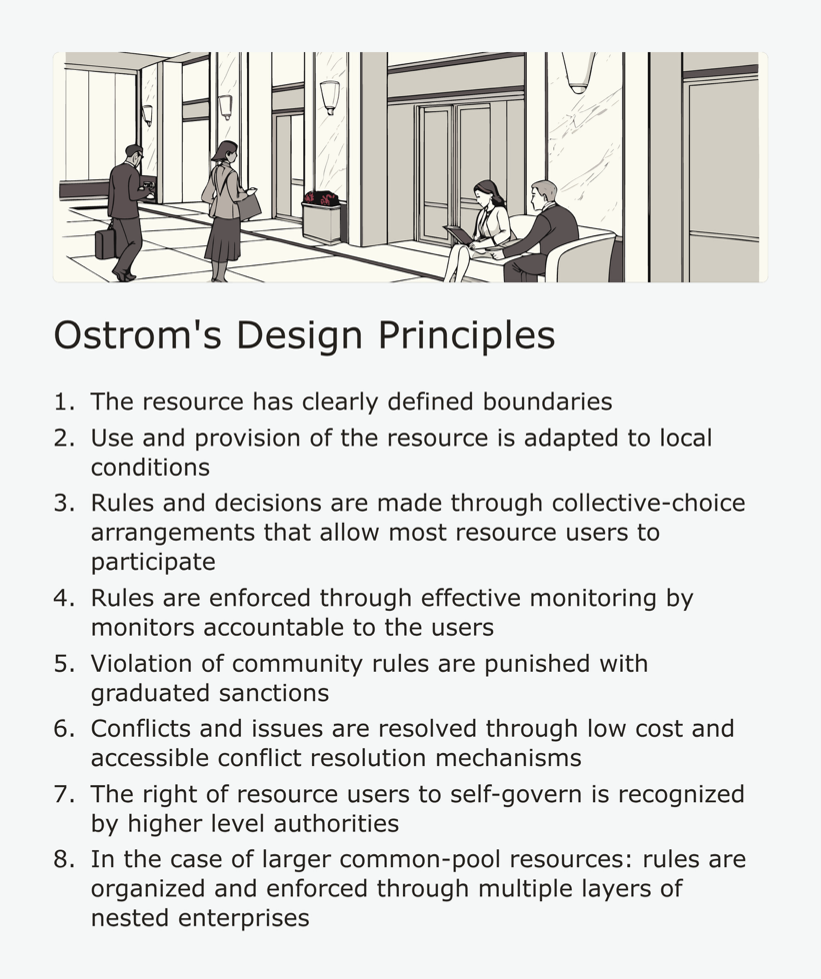
3) Collective-choice arrangements
Let the people affected by the signals help shape them. A monthly kiosk poll or short survey can invite occupants to select the metaphor for an upcoming campaign (e.g., “breathing room” vs. “carbon hourglass”), define acceptable escalation steps, or nominate decision points for cues (e.g., elevator lobbies). Participation increases relevance and reduces resistance.
4) Monitoring
Make feedback continuous, local, and accountable. Monitoring in this context is not about surveillance; it’s about ambient accountability. CO₂ climbs during a long meeting? A gentle “slowing breath” effect appears on the wall wash with a subtle tonal cue. Plug load spikes in a focus area? A subtle ripple animates above outlets. Operators remain the stewards of accuracy; occupants understand the consequence of choices, in place, in time.
5) Graduated sanctions
Ostrom warns against heavy-handed punishments. In buildings, that means avoiding shame and anxiety. Design a choice architecture ladder: begin with a hue shift or dim pulse; step up to a soft sound shimmer; finally, add a short caption: “Let’s air this out—try opening the door or tapping ‘ventilate’.” Each step is clear, respectful, and easy to act on.
6) Conflict-resolution mechanisms
Signals can confuse or conflict (“Why is this room pulsing?”). Provide fast, low-friction answers: a QR tag or NFC tap opens a 10-second explainer and choices (“ventilate now,” “snooze for 10 min,” “learn more”). Route disputes (e.g., comfort vs. conservation) to a known channel with transparent reasoning and response times.
7) Minimal recognition of rights to organize
Enable grassroots micro-stories. Give teams content slots to showcase their own 10-second loops celebrating savings or wellness actions. Let occupants propose new metaphors. When people can organize, stewardship becomes cultural—not merely top-down.
8) Nested enterprises
Design for layers: room → neighborhood → floor → building → campus. A small win in a conference room (better IAQ behavior) can trigger a gentle celebration in a nearby corridor; a floor hitting its weekly water target might unlock a building-wide visual “river” sequence. Nested feedback connects personal action to broader impact.
FROM DATA TO STORY: THREE QUICK EXAMPLES
PLACEMENT, PACING, AND COGNITIVE LOAD
Effective cues are where choices happen and when they matter. Don’t put energy stories only in the lobby if the decisions occur in kitchens and print rooms. Keep signals glanceable—legible in seconds—and predictable in pacing. Reserve sound for moments that genuinely need attention, offer captioned/text alternatives, and enforce brightness ceilings to respect neurodiversity and comfort.
PROTOTYPING PATH: START TINY, LEARN FAST
Begin with a storyboard and a sensor simulator (you can mock CO₂ or load data in a media server). Test in a single hallway or meeting room for two weeks. Evaluate legibility (“What do you think this means?”), actionability (“What would you do next?”), and comfort (“Was any cue distracting?”). Adjust thresholds, tempos, and metaphors; then scale from Pilot to Signature Moment to Systemic Layer as confidence grows. Work as a cross-functional team—sustainability, facilities, IT, AV/experience designers—and define content operations so updates don’t require custom code.
MEASURING WHAT MATTERS—WITHOUT SHAMING
Measure behavior and outcomes, not just attention. Track proxy metrics that connect to your values:
- Energy: plug loads by zone, moderated setpoints, stair uptake vs. elevator calls, demand peaks avoided.
- IAQ: time within target CO₂ band; meeting lengths vs. ventilation actions.
- Water: daily gallons saved vs. baseline; fixture dwell times.
- Space: dispersion across zones; reduced oversaturation of popular rooms.
Use pre/post surveys, A/B pilots, and season-over-season comparisons. Keep data aggregate and anonymous by default; provide opt-out zones; document accessibility accommodations (captioning, quiet paths, reduced motion options). Publish what you learn—especially what you change—so trust grows with the system.
ALIGNING WITH ORGANIZATIONAL VALUES
Values turn narratives into commitments. If water stewardship is core, give water cues the prime real estate and best craft. If wellness leads, make IAQ legibility impeccable and celebrate restorative behaviors (taking breaks, choosing daylight). If carbon intensity drives decision-making, tie visible and auditory moments to the grid’s cleaner hours. A building that “communicates” its values consistently teaches them—gently—every day.
A CALL TO HUMBLE BEGINNINGS
Pick one metric that matters, one decision point, one metaphor, and one modality. Pilot for a month. Share the story of what happened—what worked, what didn’t, and what changed. The promise is not that a light animation will save the planet. The promise is that people will better understand their role in the commons, feel the building’s feedback, and choose well together. Over time, those micro-choices compound into real performance gains and a culture of stewardship.
When buildings become narrators and people become co-authors, the commons isn’t an abstract policy—it’s the everyday story told in light, sound, and motion, right where it counts.
View More Resources
Benefit from our expertise